
By 2027, the search engine results page as we knew it for two decades will be a historical artifact for a significant portion of queries. Google’s AI Overviews and other conversational AI interfaces are no longer an experiment. They are the new front door to information for millions of users. For businesses, this shift presents a stark choice: adapt your digital strategy or risk becoming functionally invisible. The old model of ranking for ten blue links is being supplemented, and in some cases replaced, by AI-synthesized answers. This change is so fundamental that some analysts believe AI search tools threaten the business model of the open web as we have known it. Securing your position in this new paradigm is the core challenge for marketers and business owners. Achieving high AI search visibility is not about a single trick; it requires a deep, strategic realignment of how you create and structure content.
This guide outlines seven practical strategies your business must implement to ensure it is seen, cited, and recommended by AI search engines. These are not theoretical concepts. They are actionable steps based on how these systems are being built and what data they prioritize. Ignoring them is equivalent to taking down your website in 2010.
Strategy 1: Master Your E-E-A-T Signals
Google’s concept of E-E-A-T, which stands for Experience, Expertise, Authoritativeness, and Trustworthiness, has become the bedrock of content quality. For AI systems, these signals are crucial for mitigating risk. An AI model’s biggest failure is providing incorrect or harmful information. Therefore, it is programmed to favor sources that demonstrate high levels of E-E-A-T. Your goal is to make it algorithmically obvious that your content is reliable.
Improving your E-E-A-T signals for better AI search visibility involves several concrete actions:
- Detailed Author Bios: Every piece of content should be attributed to a real person with demonstrable credentials. Author pages should detail their experience, education, and professional affiliations. Link to their professional social media profiles or other publications to build a web of authority.
- Transparent Sourcing: Just as in academic writing, cite your sources. When you state a fact or a statistic, link to the original, authoritative source. This shows the AI that your claims are verifiable.
- Show, Don’t Just Tell: For “Experience,” content should reflect firsthand knowledge. If you’re reviewing a product, include original photos or videos. If you’re giving financial advice, explain the real-world scenarios you’ve encountered. AI can analyze content for markers of authentic experience.
- Regular Content Audits: Trustworthiness is perishable. Information becomes outdated. Implement a process to regularly review and update your content for accuracy. A post from 2019 about social media marketing is likely no longer trustworthy without a significant update.
Without a strong E-E-A-T foundation, any other optimization efforts will fail. The AI will simply not consider your site a candidate for its answer synthesis.
Strategy 2: Adopt a Dual AEO and SEO Approach
For years, the focus has been on Search Engine Optimization (SEO), the practice of optimizing content to rank in search results. That remains important. However, a new discipline has become equally critical: Answer Engine Optimization (AEO). While SEO gets your page into the search engine’s index, AEO gets your facts and data into the AI’s synthesized answers. This requires a shift in thinking.
The relationship between the two is symbiotic. You need a solid technical SEO foundation, including fast page speeds, mobile-friendliness, and a logical site structure, for search engines to crawl and index you effectively. But you must build upon that foundation with AEO tactics. The dual strategy of AEO and SEO is non-negotiable for future traffic. AEO focuses on providing direct, concise, and well-structured answers to the questions your audience is asking.
Practical AEO involves:
- Conversational Query Targeting: Instead of just targeting “Bellingham plumber,” optimize for “how much does it cost to fix a leaky pipe in Bellingham?” and “what to do in a plumbing emergency.”
- Structured Content: Use headings (H2, H3, H4) to break down your content into logical sections that answer specific questions. Use bulleted and numbered lists to present information in a way that is easy for an AI to parse and extract.
- The Inverted Pyramid: Answer the question directly and immediately at the beginning of a section. Provide context and further detail afterward. This differs from traditional narrative storytelling.
Strategy 3: Implement Deep, Granular Schema Markup
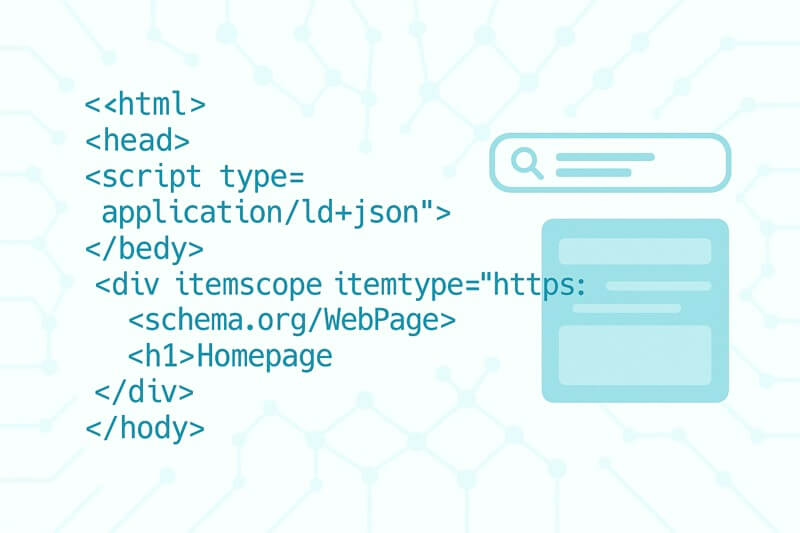
If you want an AI to understand your content, you need to speak its language. Schema markup is that language. It is a vocabulary of code that you add to your website to provide explicit context about your information. It turns ambiguous text into a structured, machine-readable format. For example, instead of just having “AgenticPress” on your page, schema can tell a search engine, “This string of text is the `legalName` of an `Organization`.”
Basic schema, like `Organization` or `Article`, is a start, but maximizing AI search visibility in 2026 requires going deeper. You must be granular and specific.
Think of your website as a collection of raw data. Schema markup is the labeling system that organizes that data into a clean, usable database for Google’s AI. The better your labels, the more likely your data will be used.
For a local business, this means using `LocalBusiness` schema and all its relevant properties: `address`, `telephone`, `openingHours`, `geo` coordinates, and `hasOfferCatalog` to list your services or products. For a content site, this means using `FAQPage` schema for question-and-answer sections, `HowTo` schema for tutorials, and `VideoObject` schema with complete transcripts. The more precise your schema, the less work the AI has to do to understand you, and the more confidence it will have in using your information in an AI Overview.
Strategy 4: Build a Robust Knowledge Graph Presence
A knowledge graph is a search engine’s understanding of the world, mapping the relationships between entities (people, places, organizations, concepts). Your business needs to be a distinct, well-defined entity within this graph. This goes far beyond your own website. It’s about establishing a consistent and verifiable identity across the web.
Building your entity presence is a long-term project that solidifies your authoritativeness. As many experts note, the future of search is deeply tied to how AI engines understand entities and their relationships. A strong entity presence acts as a powerful trust signal.
Key actions include:
- Google Business Profile (GBP): For any local or service-area business, your GBP is your most important knowledge graph anchor. It must be completely filled out, regularly updated, and actively managed.
- Data Consistency: Your business Name, Address, and Phone number (NAP) must be identical everywhere they appear online, from your website to local directories to social media profiles. Inconsistencies erode trust.
- Authoritative Mentions: Mentions of your brand or key people in reputable sources, even without a link, contribute to your entity’s profile. This includes industry publications, news articles, and partner websites.
- Structured Data: Use schema markup (specifically `sameAs`) to explicitly link your website to your other official profiles, like your Twitter/X or Facebook page, and to entries in knowledge bases like Wikidata.
Strategy 5: Prioritize Factual Accuracy and Source Citations
The biggest criticism leveled against early AI models was their tendency to “hallucinate” or present false information as fact. In response, search providers like Google are programming their AI to be more discerning. AI Overviews often feature links to the websites from which information was sourced. Your goal is to become one of those cited sources. This is a direct path to high-value traffic.
To be citable, your content must be impeccably accurate. This means adopting an almost journalistic standard for your content production. The bar for “good content” is now much higher. It must be correct, verifiable, and clearly sourced. As analyses of AI search trends consistently show, systems are being designed to reward verifiable facts over unsubstantiated claims.
Implement a content policy that includes:
- Mandatory Fact-Checking: Before any piece of content is published, every claim, statistic, and data point should be verified against a primary source.
- Outbound Linking to Authority: Do not be afraid to link out to other websites, provided they are authoritative. Linking to a university study, a government report, or a well-respected industry journal demonstrates that your information is well-researched.
- A Corrections Policy: Publicly state how you handle errors. If a reader points out a mistake, correct it promptly and transparently. This builds long-term trust with both users and search engines.
Strategy 6: Optimize for Conversational and Multimodal Search
The way people search is changing. The era of typing two or three keywords into a box is giving way to full-sentence questions spoken to a smart speaker or typed into a chat interface. Furthermore, search is no longer confined to text. Users are searching with their cameras via Google Lens and expecting answers based on images. This is multimodal search, and it is a key component of future AI search visibility.
Your content strategy must reflect this reality. Write for humans having a conversation. Structure your information to answer questions naturally. This often means using simpler language and a more direct tone. Think about the entire user journey. What is the first question they ask? What is the follow-up question? Your content should anticipate and answer that entire sequence.
To optimize for multimodal and conversational search:
- Answer “People Also Ask” Questions: Use the “People Also Ask” section of Google search results as a direct source of content ideas. Dedicate sections of your articles to answering these questions explicitly.
- Optimize Images: Use descriptive file names and detailed alt text for every image. This is not just an accessibility feature; it is how you provide data for visual search.
- Create Video Content: Video is a powerful medium for showing processes and explaining complex topics. Crucially, always provide a full transcript. AI can parse a transcript far more easily than it can “watch” a video.
Strategy 7: Create a Comprehensive Content Hub
To establish your expertise with an AI, you need to demonstrate deep knowledge of a topic, not just superficial understanding. A few scattered blog posts on a subject are no longer sufficient. The most effective strategy is to build a content hub, also known as a pillar page and topic cluster model. This structure proves your authority and makes it easy for search engines to understand the breadth and depth of your expertise, which is fundamental to how to optimize for AI search.
A content hub consists of two parts:
- The Pillar Page: This is a long-form, comprehensive piece of content that covers a broad topic from end to end. For example, a marketing agency might have a pillar page on “Local SEO.”
- The Topic Clusters: These are more specific, detailed articles that cover subtopics related to the pillar. For the “Local SEO” pillar, cluster articles might include “How to Optimize Google Business Profile,” “Building Local Citations,” and “Getting More Customer Reviews.”
Each cluster article links up to the pillar page, and the pillar page links out to all its cluster articles. This internal linking structure creates a powerful signal. It tells search engines that you have not just written one article about Local SEO, but that you are a comprehensive resource on the entire subject. This makes it far more likely that an AI will use your hub as a primary source when synthesizing an answer on that topic.
Conclusion: The Time to Act is Now
The transition to an AI-first search world is the most significant shift in the digital marketing space in over a decade. The strategies required to maintain and grow your AI search visibility are not quick fixes. They involve a fundamental commitment to quality, structure, and authority. Mastering E-E-A-T, integrating AEO with your SEO, using deep schema markup, building your knowledge graph presence, ensuring factual accuracy, optimizing for new search modes, and creating comprehensive content hubs are the pillars of success in 2026 and beyond.
Waiting to see how things shake out is not a viable strategy. By the time the full impact is obvious, catching up will be incredibly difficult and expensive. The groundwork for your visibility in 2026 must be laid today. At AgenticPress, we specialize in helping businesses navigate this new terrain, transforming their WordPress sites into assets that are primed for the age of AI search. If you are ready to future-proof your online presence, contact our team to discuss a tailored AISO strategy.