
Do AI Search Tools Threaten the Business Model of the Internet?
The digital landscape stands at a crossroads. For over two decades, the internet has thrived on a simple but powerful economic model: search engines direct users to websites, those visits generate revenue through advertising, and content creators are paid to keep producing. AI search tools like ChatGPT, Google’s Gemini, and Microsoft’s Copilot fundamentally alter this arrangement, and not everyone is prepared for what comes next.
The stakes couldn’t be higher. In 2024, U.S. online ad revenue reached $259 billion, with roughly 40% stemming from search ads. Publishers rely on organic search for over half of their typical website traffic, while small businesses depend on search visibility to connect with customers. When AI search tools can deliver instant answers without requiring users to click through to websites, the entire foundation of the free, ad-supported internet trembles.
What Are AI Search Tools?
Unlike traditional search engines that present “ten blue links,” AI search tools use large language models to understand queries and generate comprehensive, conversational responses. When you ask ChatGPT, “How do you rent office space in New York?” it doesn’t just provide links. It synthesizes information from multiple sources into a single, cohesive answer.
This technology represents a fundamental shift from information navigation to instant information delivery. Users no longer need to visit multiple websites, scan through content, or navigate ads to find what they’re looking for. The AI does the work for them, presenting distilled knowledge in seconds.
Google has responded with features like AI Overviews, which appear at the top of search results with synthesized answers. Microsoft integrated OpenAI’s technology into Bing, while newer players like Perplexity have built entire search experiences around AI-generated responses.
How Traditional Search Sustains the Internet Ecosystem
The current internet operates on a symbiotic relationship between search engines, content creators, and advertisers. Search engines crawl billions of web pages, organizing and ranking content to match user queries. Publishers create valuable content to attract those searchers, monetizing visits through display ads, affiliate links, or direct sales. Advertisers pay search engines and publishers to reach potential customers.
This model has created an unprecedented information ecosystem where:
- Content creators invest in SEO to rank higher on search results
- Publishers produce free content funded by advertising revenue
- Small businesses reach customers through organic search visibility
- Users access vast amounts of information without direct payment
The entire system depends on clicks. No clicks mean no revenue for publishers, no data for advertisers, and ultimately, no incentive to create and maintain the free content that powers the web.
The Emerging Threat: What AI Search Tools Change
AI search tools threaten this ecosystem by inserting themselves as intermediaries between users and content. When an AI provides a complete answer, users often don’t need to visit the source website, which is known as “zero-click search.” Publishers are particularly concerned about this behavior.
Early indicators support these fears. Stack Overflow, the popular programming Q&A site, saw traffic drop nearly 18% month-over-month in early 2023 as developers turned to AI tools for coding help. The company laid off 28% of its staff, directly attributing the decline to ChatGPT’s impact. Similarly, education platform Chegg’s stock plummeted 50% in a single day after its CEO acknowledged that ChatGPT was affecting subscriber growth.
Apple’s 2024 antitrust trial revelations provided the most telling data point: Safari web searches declined for the first time as users increasingly turned to AI alternatives. When Apple announced plans to integrate AI search tools directly into Safari, Alphabet’s stock lost $150 billion in market value in one day.
Who Stands to Lose (or Gain)?
Publishers Face an Existential Challenge
News organizations and content publishers find themselves in a precarious position. When AI search tools can extract and summarize their content without sending traffic, the economic model breaks down. As one media CEO privately called Google’s AI search features, it’s “a death blow.”
The concern isn’t theoretical. Studies show that organic click-through rates drop approximately 50% when Google’s AI Overview appears at the top of search results. For publishers who rely on search traffic for revenue, this represents a catastrophic threat to their business model.
Advertisers Navigate Uncertain Terrain
Search advertising faces its own disruption. If AI search tools provide complete answers, users may never see the paid listings below. Even when ads appear alongside AI responses, their effectiveness remains untested. Microsoft has experimented with ads in Bing Chat, while Google has kept AI summaries ad-free, highlighting the industry’s uncertainty about monetization.
The cost implications could be significant. If fewer users click ads, advertisers might need to pay more per click to maintain performance, or shift budgets to other channels entirely.
Small Businesses Scramble to Adapt
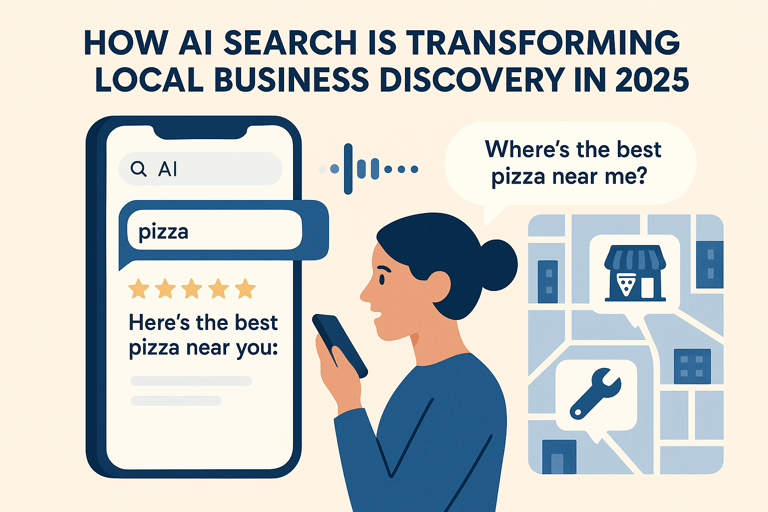
Local businesses face the biggest challenge. Without massive brand recognition, they depend heavily on search visibility to be discovered by customers. When someone asks an AI, “Find me the best plumber in my city,” the assistant might recommend just one or two options, potentially excluding businesses that would have appeared in traditional search results.
A late-2024 survey found that small business owners rated online discoverability as 8.4 out of 10 in importance, yet only 38% felt adequately represented on search platforms. The shift to AI search adds another layer of complexity to an already challenging landscape.
Business Implications & Visibility in the Age of AI Search
The transition to AI search tools demands fundamental changes in how businesses approach online visibility. Traditional SEO tactics may prove insufficient when AI systems evaluate content differently than traditional search algorithms.
Success in the AI era requires understanding how these tools select and present information. Unlike keyword-focused search, AI search tools prioritize comprehensive, authoritative content that directly addresses user needs. They favor structured data, clear organization, and explicit answers to common questions.
Businesses must also consider the potential for reduced organic reach. When AI provides instant answers, the value of creating content solely for search traffic diminishes. Companies should focus on building direct customer relationships and creating content that users actively seek out, rather than simply optimizing for discovery.
Strategic Adaptations: What Businesses Can Do
Forward-thinking organizations are already adapting their strategies for the AI search era. The key is to optimize for AI search while maintaining a traditional search presence.
Essential adaptations include:
Structured Data Implementation: AI systems excel at parsing structured information. Adding schema markup and organizing content in clear, logical hierarchies helps AI tools understand and accurately represent your business.
Authority Building: AI search tools prioritize expertise and trustworthiness. Building genuine authority through quality content, professional credentials, and consistent messaging becomes even more critical.
Multi-Channel Presence: With reduced search traffic, businesses need diversified discovery strategies. Direct marketing, social media engagement, and email lists become more valuable as primary traffic sources.
Content Strategy Evolution: Focus shifts from keyword optimization to comprehensive topic coverage. Content should directly answer user questions while providing depth that encourages website visits for additional information.
Understanding AI search trends helps businesses anticipate changes and adjust strategies accordingly. Successful companies will view AI search as an opportunity to serve better customer needs rather than simply a threat to existing traffic sources.
The Platform Response: Innovation and Preservation
Major technology companies find themselves performing a delicate balancing act. Still the dominant search player, Google has introduced AI features cautiously, maintaining traditional link-based results alongside AI summaries. This approach reflects the company’s need to preserve its advertising revenue while adapting to user expectations.
Microsoft has taken a more aggressive stance, positioning Bing as an “AI-powered copilot for the web.” The company sees an opportunity to gain market share by offering a dramatically different search experience, though Bing’s overall usage remains a fraction of Google’s.
Apple’s potential entry into AI search could prove most disruptive. With control over iPhone search defaults and no existing search advertising business to protect, Apple has more freedom to reimagine information discovery entirely.
The Economics of Information Access
The fundamental question extends beyond mere business disruption: if AI search tools reduce economic incentives for content creation, where will AI systems source their information in the future? This paradox (AI potentially “cannibalizing its own training data”) highlights the need for sustainable models that compensate content creators while serving user needs.
Some proposed solutions include:
- Revenue-sharing agreements between AI platforms and content sources
- Licensing deals for premium content access
- Direct user payments for AI services, reducing reliance on advertising
- Hybrid models that combine free AI summaries with premium, detailed content
Looking Forward: Evolution, Not Revolution
Despite dire predictions, the internet’s business model will likely evolve rather than collapse entirely. Historical precedents (from the rise of search to social media’s impact on web traffic) suggest that new equilibria eventually emerge.
AI search tools may expand information access rather than restrict it. By handling routine queries efficiently, they could free users to explore more specialized, high-value content. Publishers that adapt by creating deeper, more authoritative resources might be better rewarded in an AI-mediated landscape.
The next phase will be crucial. How search companies balance innovation with ecosystem sustainability, how publishers adapt their content strategies, and how users respond to new information access patterns will shape the internet’s economic future.
Conclusion: Adaptation as Opportunity
The rise of AI search tools undoubtedly threatens traditional internet business models, but history shows that digital ecosystems are remarkably adaptable. The companies and content creators that thrive will be those who recognize change as an opportunity and find new ways to deliver value that work within the evolving landscape.
The question isn’t whether AI search will transform the internet’s economics, but how quickly and effectively stakeholders can adapt. The ad-supported web that powered the internet’s first three decades may need to share space with subscription models, direct partnerships, and new forms of value exchange we haven’t yet imagined.
For businesses, the imperative is clear: understand how AI search tools work, adapt content and discovery strategies accordingly, and maintain direct relationships with customers independent of any single discovery channel. The internet’s business model faces its biggest challenge yet, but the foundation of providing valuable information to users remains unchanged. Only the delivery mechanisms are evolving.
As this transformation unfolds, one certainty emerges: passive observation won’t suffice. Organizations that actively engage with AI search optimization, experiment with new approaches, and maintain flexibility in their digital strategies position themselves to survive and thrive in an AI-powered information economy.
The future of digital discoverability belongs to businesses that understand and adapt to how consumers increasingly use generative AI for online searches. Companies can position themselves at the forefront of this technological transformation by embracing these changes rather than resisting them.
Sources: Recent analysis includes data from Adobe Analytics, expert commentary from The Verge, Reuters coverage of Apple’s AI search plans, case studies on Stack Overflow and Chegg, and thought leadership from industry analysts. This analysis reflects the evolving landscape through 2025, though the story continues to unfold.