
How Will AI Affect Jobs: Market Trends Through 2030
According to a 2025 survey, 71.5% of Americans have already used AI tools, with adoption rates highest among younger generations. As artificial intelligence moves from experimental labs to everyday workplaces, a pressing question emerges: how will AI affect jobs in the coming years? Will machines displace workers, enhance their capabilities, or create new career paths?
This comprehensive analysis examines current trends and future projections through 2030, identifies the most vulnerable and resilient job categories, and offers practical guidance for professionals navigating this technological transition. By analyzing expert forecasts, research data, and industry transformations, we aim to provide a balanced view of what lies ahead in the AI-influenced job market.
The Current Impact: How AI Is Already Affecting Jobs
The integration of AI into workplaces isn’t a distant prospect. It’s happening now. Rather than causing widespread unemployment, AI’s current influence represents a mix of task automation, job transformation, and productivity enhancement.
A recent McKinsey Global Institute report reveals that nearly one-quarter of companies have already begun replacing specific roles with AI. In May 2023, approximately 3,900 U.S. job cuts were attributed directly to AI implementations, about 5% of that month’s layoffs, marking one of the first measurable signs of AI-driven workforce reduction.
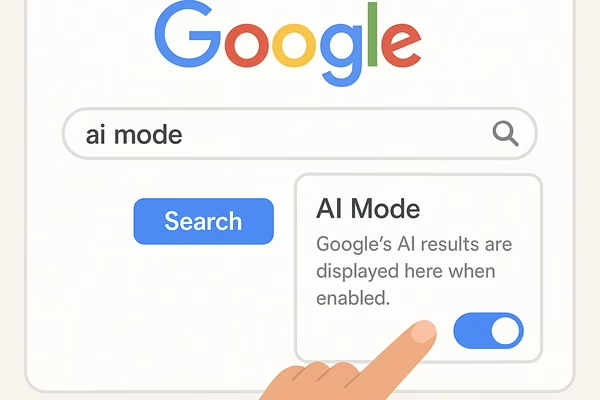
However, unemployment overall remains near historic lows in 2024-2025. This suggests that AI’s impact so far is more about changing the nature of work than eliminating jobs. AI search tools are transforming how professionals find information, shifting from traditional keyword queries to conversational, intent-driven discovery that delivers more precise results.
In healthcare, AI helps ease administrative burdens without replacing doctors or nurses. Hospitals use AI systems to automate appointment scheduling, transcribe medical notes, and analyze health records. “Ambient” AI documentation tools can listen to doctor-patient visits and draft medical notes in seconds, a task previously done by human scribes.
The finance sector has embraced AI to streamline operations and enhance customer service. Many tasks once performed by entry-level analysts are now automated by AI systems, which review loan applications, flag fraud, and generate basic financial reports. Major banks have deployed AI-powered virtual assistants to handle customer inquiries 24/7, reducing the need for large call-center teams.
Customer service has felt AI’s immediate impact most strongly. Call centers now routinely deploy AI chatbots as the first line of customer interaction. By 2024, 80% of customer service organizations were using some form of generative AI in their operations.
Expert Forecasts: How Will AI Affect Jobs Through 2030
Analysts agree that AI will significantly reshape the labor market through 2030, though with varying estimates of its net impact.
The McKinsey Global Institute projects that tasks accounting for up to 30% of hours worked in the U.S. could be automated by 2030, thanks mainly to advances in generative and agentic AI. This doesn’t mean a third of jobs vanish, roughly a third of what people do in their jobs might be handled by machines.
Goldman Sachs estimates that new AI technology could automate the equivalent of 300 million full-time jobs globally, with about a quarter of work tasks in the U.S. and Europe potentially replaced or assisted by AI, according to their comprehensive global economic research.
Rather than instantaneous job losses, experts foresee a period of occupational transition. McKinsey anticipates that by 2030, roughly 12 million U.S. workers will likely need to transition to new occupations due to AI and automation’s impact on demand. Lower-wage workers are especially vulnerable, up to 14 times more likely to need to change jobs than high-wage workers in this decade.
The World Economic Forum’s Future of Jobs Report suggests that job creation will still outpace job elimination by 2030. They estimate that about 170 million new jobs could be created and 92 million eliminated, for a net gain of +78 million jobs worldwide (approximately +2.3% net growth).
Will AI Create More Jobs Than It Eliminates?
The impact of AI will not be uniform across sectors. Knowledge industries like finance, law, and media will see AI handling more cognitive tasks. In contrast, manual labor sectors such as construction and agriculture may experience less automation due to technical constraints.
The Organisation for Economic Co-operation and Development (OECD) finds that even high-skill occupations are now exposed. Generative AI’s ability to perform cognitive, non-routine work means that many white-collar jobs have a high share of tasks that AI could perform. Their analysis revealed that 32% of jobs in urban regions are highly exposed to generative AI (versus 21% in rural areas).
Customer service and clerical jobs are projected to continue declining through 2030. By contrast, healthcare and tech roles are expected to grow. Due to aging demographics, U.S. demand for healthcare workers is predicted to continue rising through 2030, somewhat insulating that sector from net job loss.
Several institutions share the positive outlook that AI could spark a productivity boom that raises global GDP and creates new economic sectors. Goldman Sachs predicts AI could boost global GDP by ~7% over time. McKinsey’s midpoint scenario estimates that generative AI could lift U.S. labor productivity growth by 0.5 to 0.9 percentage points annually through 2030, a significant bump, given that recent productivity growth was near zero.
This explains why businesses across industries invest in AI agents to automate routine tasks, analyze data more efficiently, and make better decisions. These AI-powered solutions are helping companies stay competitive while allowing human workers to focus on higher-value activities.
Jobs Most Likely to Be Transformed: How Will AI Affect Jobs in Vulnerable Sectors
Not all jobs face equal risk from AI automation. Some occupations are highly susceptible because they involve routine, repetitive tasks or predictable decision-making that AI can learn. Others remain relatively shielded because they require human traits that AI struggles with.
Administrative and Clerical Roles: Office support jobs top the lists for AI disruption. This includes data entry clerks, executive assistants, secretaries, bookkeeping clerks, and receptionists. These roles primarily involve information processing, form-filling, scheduling, and other routine tasks that modern AI can handle efficiently.
The U.S. Bureau of Labor Statistics projects office support jobs could decline by about 3.7 million positions by 2030 due to automation. AI scheduling assistants and document management systems are already reducing the need for large administrative staff.
Customer Service and Call Center Agents: AI-driven chatbots and voice agents can handle many customer inquiries. McKinsey’s analysis anticipates a decline of roughly 2 million customer service jobs in the U.S. by 2030 as AI takes on more of this work.
Routine sales roles like cashiers and ticket clerks also fall into this category. Automation, such as self-checkout kiosks and AI-powered e-commerce interfaces, is rapidly reducing demand for these positions.
Manufacturing and Production Operatives: Factory jobs involving assembly, machine operation, and quality inspection are highly automatable. Now often equipped with AI vision and learning capabilities, industrial robots can perform repetitive assembly line tasks and adjust on the fly.
A PwC analysis suggests up to one-quarter of manufacturing jobs could be at high risk of automation by the late 2020s, especially in electronics and automotive assembly. Autonomous forklifts and sorting robots are displacing roles like forklift drivers and package sorters in warehousing.
Routine Middle-Management and Coordination Roles: A newer category on the “at-risk” list includes certain junior managerial or analyst roles that involve routine coordination, report generation, or basic decision-making.
Gartner predicted that by 2030, AI, such as software that automatically updates project statuses and flags issues, might eliminate up to 80% of project management tasks. Similarly, entry-level jobs in consulting or finance, like financial analysts who build standard Excel models or consulting associates who make slide decks, could see reduced demand.
Basic Content Creation and Processing Jobs: AI’s content generation ability makes straightforward content production roles vulnerable. Technical writers, basic graphic designers, junior journalists, and translators may find their work increasingly automated.
Companies may employ fewer people for these tasks, using AI to create a first draft that one human can oversee. AI has heavily impacted translation and transcription jobs—services like Google Translate and speech-to-text APIs perform translations that once required skilled humans.
Jobs Least Likely to Be Disrupted by AI
Healthcare and Caregiving Professions: Roles involving personal care, empathy, and physical interaction are among the least automatable. Nurses, medical assistants, therapists, and home health aides all require a human touch, from comforting a patient to making nuanced care decisions on the fly.
While AI will aid diagnosis and administrative tasks in healthcare, caregiving itself remains a human domain. Demand for more care jobs is rising, not falling. The WEF notes that the number of jobs in the care economy (nurses, elderly caregivers, child care workers) is expected to grow significantly through 2030.
Education and Training: Teachers, professors, and corporate trainers are resilient to AI disruption. While AI tutors and learning apps will handle some instructional tasks, human educators provide mentorship, motivation, and social learning experiences that AI cannot replicate well.
Elementary and secondary school teachers are among the occupations projected to grow in the coming years. While teachers may focus more on higher-level cognitive and social skills, while AI covers drills, outright job loss is not anticipated at scale here.
Creative and Artistic Endeavors (High-End): Creativity is a complex trait, and while AI can mimic certain artistic styles or generate content, truly original creative work often requires human inspiration and cultural context. Artists, creative directors, novelists, and research scientists pushing knowledge frontiers are less at risk.
Creative professionals who can harness AI as part of their toolkit may become more in demand, not less. The jobs most secure in this domain are those where the human’s unique vision or brand is the selling point.
Trades and Hands-on Technical Jobs: Many skilled trades require mobility, dexterity, and problem-solving in unstructured environments. Things AI and robots struggle with. Electricians, plumbers, carpenters, automotive repair technicians, and aircraft mechanics all involve troubleshooting unique situations in varied physical settings.
A plumber diagnosing an unusual leak or an electrician rewiring an old building each face bespoke tasks that a general-purpose robot can’t easily navigate. By 2030, skilled trade jobs will likely remain plentiful, and a potential shortage of such workers is a bigger concern than AI replacement in those fields.
Industry Analysis: How Will AI Affect Jobs Across Different Sectors
Healthcare: AI is transforming healthcare by assisting with diagnostics, streamlining administrative processes, and enhancing patient care. Medical imaging analysis powered by AI can detect patterns that might escape the human eye, while predictive analytics help identify patients at risk for certain conditions.
However, the human elements of healthcare, such as empathy, ethical decision-making, and complex clinical judgment, remain firmly in human hands. A study in the Journal of the American Medical Association found that AI tools are most effective when they augment rather than replace healthcare providers.
Finance: The finance industry has been at the forefront of AI adoption. Algorithmic trading, fraud detection, and automated customer service are now standard features of the banking landscape. Investment analysis, once requiring teams of analysts, can now be performed rapidly by AI systems that process vast amounts of market data.
Yet, financial advisors who build client relationships and provide personalized guidance remain valuable. The human touch in financial planning, especially during market volatility or major life transitions, is essential for client trust and satisfaction.
Manufacturing: Smart factories represent the future of manufacturing, with AI-powered robots and systems handling everything from production to quality control. These technologies boost efficiency, reduce errors, and improve safety by taking over hazardous tasks.
The future manufacturing jobs will focus less on repetitive assembly and more on programming, maintaining, and supervising advanced machinery. Workers who can bridge the gap between technical systems and production goals will be particularly valuable in this transformed environment.
Education: AI is personalizing learning experiences, automating grading, and providing round-the-clock tutoring for students. These tools allow educators to focus on what they do best: inspiring curiosity, fostering critical thinking, and building relationships with learners.
Teachers who embrace AI as a tool for enhancing their practice rather than seeing it as a threat will thrive in the evolving educational landscape. Research from Stanford University suggests that AI will not replace teachers but will require them to develop new skills for an AI-enhanced classroom.
Retail and Customer Service: AI is reshaping the retail experience through personalized recommendations, automated inventory management, and seamless checkout experiences. Virtual shopping assistants can guide customers through product selections, while back-end systems ensure products are available when and where customers want them.
Human retail workers are shifting toward roles emphasizing product expertise, personal service, and creating memorable in-store experiences that online shopping can’t match. AgenticPress helps businesses optimize their online presence to stay competitive in this rapidly evolving digital marketplace.
Preparing for an AI-Transformed Economy: How Will AI Affect Jobs You’re Seeking
As AI reshapes the job market, workers must adapt to remain relevant and competitive. Here are key strategies for navigating this transition:
Embrace Lifelong Learning: Continuously update your skills, focusing on areas that complement AI. Industry reports consistently find growing demand for skills in data analysis, AI literacy, programming, and digital fluency. Even more importantly, “soft skills” like creativity, critical thinking, and communication become more valuable when routine work is automated.
Seek out training programs in emerging technologies, attend workshops, earn certifications, or consider formal education for a mid-career boost. The mindset to cultivate is being a lifelong learner, ready to acquire new competencies as jobs evolve.
Develop Your Human Uniqueness: In an AI-rich world, the tasks left for humans will often play to our unique abilities. Focus on strengthening skills that AI lacks: interpersonal communication, empathy, leadership, complex problem-solving, and adaptability.
Workers who can bridge the gap between AI and people, such as consultants who translate AI outputs into business strategies, or nurses who use AI diagnostics but deliver compassionate care, will be in strong demand.
Leverage AI as a Productivity Tool: Rather than fearing AI, use it to your advantage. A growing array of AI applications can automate mundane parts of your job or enhance your output. By adopting these tools, you can increase your productivity and value to your employer.
In many professions, those who adeptly use AI will outperform those who don’t. So, stay informed about AI developments in your field and experiment with new tools. Becoming fluent in the strengths and weaknesses of AI will set you apart as a forward-thinking professional.
Be Adaptable and Open to Career Shifts: Flexibility is a huge asset in fast-changing times. The job you start with may evolve into something different, or entire roles may sunset. Be open to pivoting into new roles or industries where your skills (plus some retraining) could apply.
Start planning now if you’re in a role likely to be disrupted. This might involve mapping your transferable skills and identifying where they could be valuable. Keep an eye on job market trends and growth areas—fields like healthcare, technology, renewable energy, and education are generally expected to expand.
Navigating the Future of Work in an AI-Enhanced World
How will AI affect jobs in the long term? The evidence suggests a nuanced picture. While specific roles will decline or disappear, others will transform or emerge anew. The key is not to resist technological change but to adapt alongside it.
The next few years will test our ability to manage this transition effectively. Countries, companies, and individuals investing in education, retraining, and creating complementary human-AI workflows will likely fare better than those allowing automation to displace workers without a plan.
History shows that technological revolutions, from the steam engine to the internet, have ultimately created more jobs than they eliminated. However, the transition period can be challenging, and the benefits don’t automatically flow to everyone equally.
By focusing on developing distinctly human capabilities, learning to work effectively with AI tools, and remaining flexible about career paths, today’s workers can position themselves to thrive in tomorrow’s job market.