
Why AI Search Tools Are the Future of Information Discovery
Remember the last time you typed a question into a search bar? You probably got a list of ten blue links and spent the next few minutes clicking through them, piecing together the answer yourself. That familiar ritual is quickly becoming a relic of the past. We’re standing at the edge of a monumental shift in how we find information, a change driven by the rapid evolution of AI search tools.
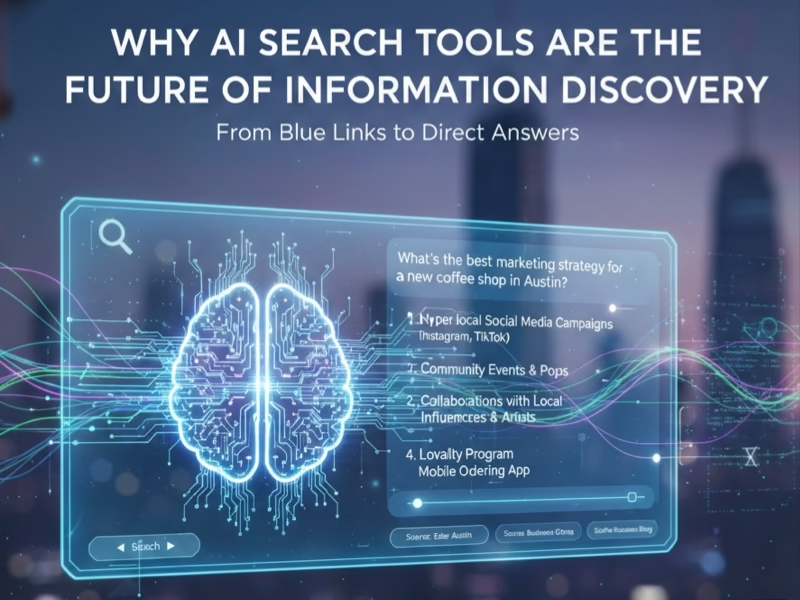
It’s no longer just about finding websites; it’s about getting direct, comprehensive answers. Imagine asking a complex question like, “What’s the best marketing strategy for a new coffee shop in Austin, considering local demographics and a budget of $5,000?” and getting a synthesized, actionable plan in seconds. This isn’t science fiction. This is the reality that AI search tools are building, and for businesses, being unprepared isn’t an option.
The Great Unbundling: From Search Engine to Answer Engine
For two decades, the search engine model has remained essentially unchanged. You ask, it provides a list of potential sources, and you do the work of finding the answer within those sources. But generative AI has flipped the script. The new generation of AI search tools, like Google’s AI Overviews, Perplexity AI, and ChatGPT, aren’t just pointing you to information; they’re consuming, understanding, and synthesizing it for you.
This transforms them from “search engines” into “answer engines.” The core difference lies in the final output. Instead of a ranked list of documents, you receive a narrative, a summary, or a direct solution crafted from multiple sources. According to recent data, this is a change users are embracing. A staggering 66% of people who use large language models now prefer them over traditional search for their primary information needs.
This isn’t just a new feature; it’s a fundamental reimagining of information discovery. The goal is no longer to be the best link on the page but to be the most trusted source in the AI’s answer.
How Do These New AI Search Tools Work?
At their core, these tools are powered by Large Language Models (LLMs) trained on vast datasets from the internet. When you pose a query, they don’t just match keywords. Instead, they understand the intent and context behind your question. Here’s a simplified breakdown of the process:
- Natural Language Understanding (NLU): The AI first deciphers what you’re actually asking, even if your query is conversational or complex.
- Information Retrieval: It then scans and pulls relevant information from its training data and, in many cases, from the live web.
- Synthesis and Generation: This is the magic step. The AI doesn’t just copy and paste. It synthesizes the information from various sources, reconciles conflicting data (to the best of its ability), and generates a new, coherent, and human-like response.
- Citation (Sometimes): Leading platforms like Perplexity AI and Google’s AI Overviews often include citations, linking back to the sources they used to construct the answer. This is a crucial feature for building trust.
This process results in a much richer, more efficient experience. The AI does the heavy lifting of research and consolidation, delivering the “so what” directly to you.
Meet the New Titans: Who Is Shaping the Future of Search?
While Google has long been the undisputed king of search, the landscape is now a dynamic arena with several powerful players. Understanding their unique approaches is key to grasping where the future is headed.
Google’s Two-Pronged Attack: AI Overviews and AI Mode
Google is aggressively integrating AI directly into its search results. You’ve likely already seen AI Overviews—the summarized answer boxes that appear at the top of the page for many queries. These summaries are now present in about 18% of all global Google searches, fundamentally changing the user experience.
Beyond that, Google is rolling out a more immersive “AI Mode,” which aims to be a “thought partner.” Powered by its advanced Gemini models, this mode enables multi-step, conversational queries, allowing the AI to help you plan, brainstorm, and solve complex problems without ever leaving the search page. This is a clear signal that Google sees its future not just as a directory, but as an active assistant.
OpenAI’s ChatGPT: The Conversational Pioneer
ChatGPT may not have started as a traditional search engine, but its browsing capabilities have made it a formidable tool for information discovery. Users can have deep, evolving conversations, asking follow-up questions and refining their queries in ways traditional search bars don’t allow. Its strength lies in its conversational depth and ability to generate creative, detailed content based on the information it finds.
Perplexity AI: The Answer Engine for Researchers
Perplexity AI has carved out a niche by focusing on accuracy and transparency. It positions itself as a “conversational answer engine” and excels at providing direct, well-sourced answers. Every response is backed by precise, numbered citations, making it easy for users to verify the information. This makes it a favorite among researchers, students, and professionals who need to trust the source of their information.
The Undeniable Benefits of an AI-Powered Search World
The transition to AI-driven discovery brings a wave of advantages for both users and businesses who know how to adapt. This isn’t just about a cooler interface; it’s about unlocking new levels of efficiency and insight.
For Users: Speed, Personalization, and Clarity
The most immediate benefit is speed. Instead of spending 15 minutes sifting through articles, you get a synthesized answer in seconds. This is especially true for complex, multifaceted questions that previously required significant research.
Furthermore, AI search tools are becoming increasingly personalized. They learn from your previous interactions to provide more relevant answers, acting less like a public library and more like a personal research assistant who understands your needs and preferences. This leads to a more intuitive and less frustrating search experience.
For Businesses: Deeper Insights and Better-Qualified Traffic
While the threat of reduced traffic is real (more on that later), there’s a significant upside. The traffic that does come from an AI-generated answer is often more qualified. If a user clicks a citation link within an AI Overview, it’s because they want to go deeper into a topic the AI has already framed for them. They aren’t just browsing; they’re actively seeking expertise.
Moreover, the types of queries people use with AI search tools are longer and more specific. This provides businesses with a goldmine of data about customer intent. By analyzing these queries, you can gain a much clearer understanding of your audience’s pain points, questions, and needs, allowing you to create more targeted and compelling content.
Navigating the New Challenges: Trust, Traffic, and Transparency
Of course, this paradigm shift isn’t without its hurdles. The rise of AI search tools introduces new challenges that businesses and users must navigate carefully.
The “Zero-Click” Conundrum
The most pressing concern for many online businesses is the rise of the “zero-click” search. If the AI provides a complete answer on the results page, what’s the incentive for a user to click through to your website? Data shows this is a valid fear. Organic click-through rates can fall dramatically when an AI Overview is present. This directly threatens traditional business models that rely on advertising revenue and website traffic, a reality that challenges the very foundation of online media.
The Trust and Misinformation Dilemma
AI models are not infallible. They can “hallucinate” or generate incorrect information with complete confidence. We’ve all seen the headlines about Google’s AI recommending users add glue to their pizza or eat rocks. While often humorous, these errors highlight a serious problem. As we become more reliant on AI-generated answers, how do we ensure their accuracy and combat the spread of misinformation? Building and maintaining user trust is the single biggest challenge these platforms face.
Algorithmic Bias
AI systems learn from the data they are trained on. If that data contains historical biases, the AI will learn and perpetuate them. This can lead to skewed or unfair search results, reinforcing stereotypes and marginalizing certain viewpoints. Addressing this requires developers to make a conscious, ongoing effort to ensure their models are trained on diverse, representative datasets.
How to Adapt and Thrive in the Age of AI Search
The future isn’t about fighting this change; it’s about adapting your strategy to align with it. The good news is that the principles of creating high-quality, valuable content are more important than ever. Here’s how you can prepare your WordPress site for this new frontier.
- Embrace Generative Engine Optimization (GEO): Your focus must shift from traditional SEO to what we call Generative Engine Optimization (GEO). This means structuring your content so that it’s easily digestible and citable by AI. Think clear headings, concise language, and direct answers to common questions.
- Prioritize E-E-A-T: Google’s concept of Experience, Expertise, Authoritativeness, and Trustworthiness (E-E-A-T) is paramount. AI systems are being designed to prioritize information from sources that demonstrate deep expertise and are widely trusted. Showcase author credentials, cite your sources, and build your brand’s authority.
- Implement Structured Data: Use Schema Markup to give search engines explicit context about your content. This structured data helps AI understand what your content is about, whether it’s a recipe, an event, a product, or an FAQ, increasing the likelihood it will be featured in rich results and AI answers.
- Create “Source-Worthy” Content: Don’t just write blog posts. Create definitive guides, original research, and data-backed reports that AI will want to cite. Think about becoming the primary source of information in your niche. A comprehensive guide on optimizing for AI search can position you as an authority.
The Future is Agentic and Inevitable
The evolution of AI search tools is just getting started. The next wave involves “agentic AI,” where AI doesn’t just answer your questions but takes action on your behalf. Imagine an AI that not only finds the best restaurants but also books a reservation for you, adds it to your calendar, and arranges transportation. The rise of AI agents for business will further blur the lines between searching for information and accomplishing tasks.
The shift from a list of links to a direct, synthesized answer is profound. It challenges old strategies but opens up incredible new opportunities for those willing to adapt. The future of information discovery is conversational, contextual, and increasingly automated. By focusing on creating high-trust, high-value, and well-structured content, you can ensure your business isn’t just a passive source for an AI to scrape, but a trusted partner in its quest to provide answers.
Are you ready to adapt your digital strategy for the age of AI search? The change is happening now, and the businesses that act today will be the authorities of tomorrow. If you’re unsure where to start, our team at AgenticPress specializes in making WordPress websites visible and valuable to the next generation of AI search tools. Schedule a free AISO analysis to see how your site stacks up.