
AI Content Generation in WordPress: A 5-Step Masterclass to Attract More Local Customers Now
AI content generation presents a powerful solution for local businesses struggling to produce a steady stream of relevant articles that attract nearby customers. If you’re using WordPress, you understand the constant pressure to create quality content that ranks in local search results and draws in your community, all while managing the day-to-day demands of your business. The time and resources required can feel overwhelming, leaving your site’s potential untapped.
This masterclass cuts through the noise with an actionable framework tailored specifically for the WordPress platform. We will move beyond generic advice and into a practical, five-step process you can implement directly from your dashboard. The goal is to transform your website into a magnet for local foot traffic and qualified online leads by leveraging AI for hyper-local quality, not just quantity.
Your journey to mastering local content begins with a solid foundation.
The Strategic Advantage of AI Content Generation for Local Businesses
For most local business owners, the biggest marketing challenge is a familiar one: a constant lack of time. You need a steady flow of high-quality, neighborhood-focused content for your WordPress site to stay relevant, but daily operations demand your full attention. This is where automated content creation becomes an indispensable ally, a concept supported by the U.S. Small Business Administration’s guide to AI for small businesses.
These new technologies are powered by Natural Language Generation (NLG), a branch of artificial intelligence that transforms data and keywords into human-like text. For a local business, this means you can finally produce blog posts, service descriptions, and community updates at a scale that was previously impossible. It’s the solution to maintaining a vibrant, active online presence without sacrificing your primary responsibilities.
Key Stat: According to data reported by Search Engine Roundtable in 2018, nearly half (46%) of all searches on Google have local intent, making a consistent stream of localized content more critical than ever for discovery.
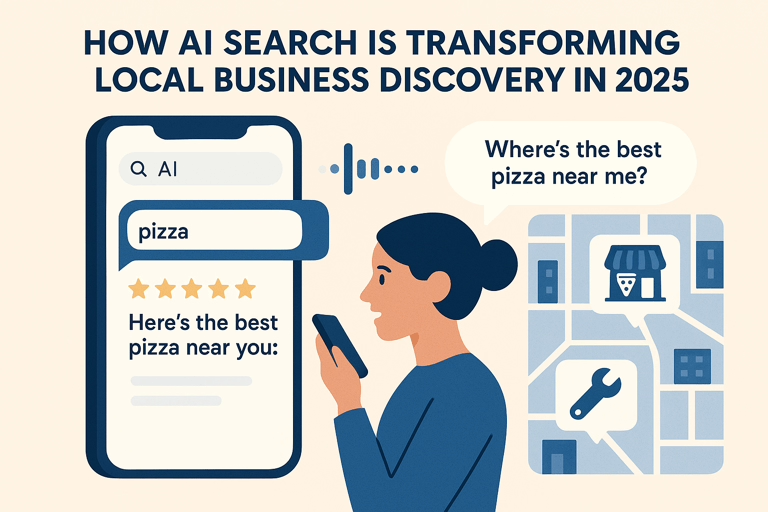
The need for this strategy is accelerating as search itself becomes more intelligent. As search engines increasingly provide direct, AI-driven answers, your online visibility depends on having a deep well of specific, relevant information about what you do and where you do it. Tools like ChatGPT demonstrate how accessible this technology has become, allowing you to create this content efficiently.
Automated content tools offer several key benefits:
- Speed and Scale: Generate drafts in minutes, not hours, allowing you to maintain a consistent publishing schedule.
- Hyper-Local Focus: Quickly create content tailored to specific neighborhoods, local events, or community news.
- Resource Efficiency: Overcome the limitations of a small team by automating the initial drafting process.
By leveraging these capabilities, you can turn your website from a static brochure into a dynamic resource that actively attracts and engages customers in your area. This strategic shift ensures you can compete effectively in a search landscape that prioritizes rich, localized information.
Step 1: Building Your Local AI Content Generation Strategy
A powerful content engine requires a solid blueprint. Before you generate a single word, you must build a content strategy that connects your business goals to what your local customers are actively searching for. This planning phase ensures every piece of content serves a purpose: attracting and converting your ideal audience.
Start by using generative AI as a brainstorming partner. Ask it to identify hyper-local topics that will resonate with your community. Think about content pillars like neighborhood-specific guides, recaps of local charity events, or case studies featuring well-known local clients. These ideas create an immediate connection with readers in your service area.
With your topics in mind, the next step is local keyword research. While premium tools like Semrush and Ahrefs offer deep analytical capabilities, AI can uncover valuable search terms you might otherwise miss. Focus on identifying long-tail keywords (hyper-specific, multi-word phrases) and voice search queries, which often reveal high purchase intent (e.g., “where can I find emergency plumbing service near me?”).
💡 Pro Tip: Prompt your AI assistant with: “Act as a local marketing expert for a [your business type] in [your city/neighborhood]. Brainstorm 10 blog post ideas that address common customer problems and include keywords a local resident would use.”
Finally, map your keywords to the customer journey to plan your content types effectively. This ensures you are creating the right asset for the right person at the right time.
- Informational Keywords: Target users in the awareness stage with blog posts (“What Causes a Leaky Faucet?”) and neighborhood guides.
- Commercial Keywords: Engage users in the consideration stage with local landing pages (“Best Plumbers in [Your Neighborhood]”) and in-depth case studies.
- Transactional Keywords: Convert users who are ready to buy with service pages and timely Google Business Profile (GBP) posts that announce special offers or appointment availability.
This strategic foundation transforms your automated content efforts from random shots in the dark into a targeted campaign that drives real-world results.
Step 2: Choosing and Integrating the Right WordPress AI Tools
With your content strategy defined, the next move is to embed artificial intelligence directly into your WordPress environment. The right plugin will feel less like a separate tool and more like a natural extension of your workflow. WordPress AI Plugins generally fall into three categories.
First are standalone platforms like Jasper, which offer powerful, versatile writing capabilities. These often operate outside of WordPress, requiring you to copy and paste the generated text, though some are developing direct integrations. Second, we have integrated SEO tools. Plugins such as Rank Math and AIOSEO have added AI features directly into their existing SEO frameworks, allowing you to create and optimize content in one place. Finally, page builder add-ons bring AI assistance into the visual design process for editors like Elementor.
Choosing the best tool depends entirely on your needs. The right platform simplifies your AI content generation process; consider integrating it into your workflow. If you primarily use WordPress’s native Gutenberg editor, an SEO plugin might be the most seamless fit. If your site is built with Elementor, its own AI tool could be more intuitive. Also, evaluate the quality of the AI output and the pricing structure, as many operate on a credit system.
For most users, an integrated SEO plugin offers the best balance. Here’s how to quickly set one up using Rank Math as an example:
- Install and Activate: From your WordPress dashboard, navigate to “Plugins,” click “Add New,” search for “Rank Math SEO,” and then install and activate it.
- Enable the AI Module: In the Rank Math dashboard, go to the “Modules” tab and activate the “Content AI” module.
- Connect Your Account: You will be prompted to connect a free Rank Math account to activate the Content AI feature. This authenticates your site and gives you access to your credits.
- Configure Settings: Go to
Rank Math SEO > General Settings > Content AIset your default audience, tone, and language to ensure the generated text aligns with your local brand voice.
Step 3: Crafting Hyper-Local Content with AI Prompts
Generic, robotic-sounding text is the fastest way to lose a local customer’s trust. The key to unlocking high-quality, locally nuanced output from models like ChatGPT and Gemini is prompt engineering: the practice of strategically writing AI prompts. Effective prompts act as a detailed creative brief for your AI assistant.
The best prompts provide four key elements. First, give detailed context about your business and the content’s goal. Second, define the tone you want, such as “professional yet friendly” or “urgent and promotional.” Third, specify the format (e.g., “a 300-word blog post,” “a bulleted list,” “a social media update”). Finally, include constraints such as “do not use jargon” or “write at a 9th-grade reading level.”
Here are a few templates to get you started:
- Local Event Blog Post: “Write a 400-word blog post about the upcoming [Event Name] in [City, State]. Our business, [Your Business Name], is a [Business Type] located in the [Neighborhood Name] neighborhood. The tone should be excited and community-focused. Mention the event’s date, location at [Landmark], and one fun activity. End with a call-to-action inviting readers to visit us before or after the event.”
- Neighborhood-Specific Service Page: “Create content for a service page targeting the [Neighborhood Name] neighborhood. I am a [Service Provider, e.g., ‘plumber’]. The tone should be helpful and trustworthy. Mention our proximity to [Local Landmark] and our familiarity with the area’s common issues, such as [Common Local Problem]. Include a section on our [Specific Service] and why it’s beneficial for homeowners in [Neighborhood Name].”
- Google Business Profile Update: “Draft a 150-word Google Business Profile (GBP) update about our new seasonal offer: [Offer Details]. Our hours are [Your Hours]. The tone should be direct and promotional. Include a link to our website and use the phrase ‘limited time offer.”
This level of detail is what elevates your use of this technology beyond basic AI content generation. By referencing specific landmarks, local news, or even regional slang, you create content that resonates deeply with a local audience.
💡 Pro Tip: Don’t expect the perfect result on your first try. Treat your first prompt as a draft and refine it based on the AI’s output. Once you craft a prompt that delivers great results for a specific task, save it in a document. This creates a powerful template library you can reuse to ensure consistency and save time.
Step 4: Optimizing and Publishing Your AI-Generated Content
An AI-generated draft is a powerful starting point, but it is never the finish line. The crucial next step is the edit and refine phase, where human oversight transforms a generic draft into a valuable, customer-facing asset. This is where you infuse your unique brand voice, correct any potential inaccuracies, and add personal expertise that no algorithm can replicate.
Successful publishing requires a deliberate, three-part optimization process. It ensures your final piece is polished, professional, and primed for local search visibility.
-
Perform a Thorough Human Edit. Before you consider publishing, rigorously review the text. Fact-check every claim, especially data or local references. Rewrite sentences to reflect your company’s personality and tone. Most importantly, weave in your own stories, customer experiences, and hard-won knowledge to provide genuine value.
-
Enhance On-Page SEO. With a refined draft, focus on search engine optimization. This is where WordPress plugins become essential. Tools like Yoast SEO or Rank Math guide you through optimizing your page title, meta description, and keyword usage. These elements are critical signals for search engines, helping them understand what your content is about and who it’s for. Proper use of these tools is fundamental to an effective AI content generation strategy.
-
Implement Local Schema Markup. Explicitly tell search engines about your business by implementing local schema markup. This structured data provides clear details like your address, phone number, and business hours directly to Google. Both Yoast SEO and Rank Math offer simple ways to add this markup, which can significantly improve how your business appears in local search results, including map-based queries.
Key Stat: According to a 2018 BrightLocal report, 80% of consumers lose trust in a local business if they find incorrect or inconsistent contact details online.
This meticulous optimization is non-negotiable. It bridges the gap between a machine-generated draft and content that truly resonates with local customers. By carefully editing, optimizing for on-page factors, and structuring your data, you create a final asset that builds trust and drives measurable results for your local business.
Step 5: Measuring Performance and Refining Your Local Strategy
Creating content is only half the battle; true success lies in measurement. To ensure your efforts are driving real results, you must consistently track performance. This data-driven approach helps you understand what resonates with your local audience and refine your strategy for maximum impact.
Focus on key performance indicators (KPIs) that directly reflect local success. You need specific, geographically-focused data to make informed decisions about your content strategy.
- Local Rank Tracking: Monitor your position on Google for important local keywords, like “plumber in Brooklyn.” An increase in these rankings directly correlates with your visibility.
- Geographic Traffic: Use Google Analytics to confirm where your visitors are located. A successful local strategy shows a growing percentage of traffic from your target service areas.
- Google Business Profile Insights: Track conversions on your Google Business Profile (GBP). Pay close attention to clicks for directions, phone calls, and website visits from your profile, as these are strong buying signals.
Manually tracking local rankings across different neighborhoods is impossible. Specialized tools are invaluable, offering an automated, accurate view of your true market visibility.
Services like Local Falcon and BrightLocal lead this space. They use grid-based tracking to show how you rank block-by-block and offer deep insights into competitor activity, giving you a significant strategic advantage.
The ultimate goal is to create a powerful feedback loop. Analyze your top-performing articles. Do listicles about local events drive more traffic? Do in-depth guides generate more calls from your GBP? Identify these patterns.
Use these insights to refine your future AI content generation prompts. By understanding what works, you can guide your tools to create more effective and targeted articles, continuously improving your results.
💡 Correlate spikes in your GBP impressions with the publish dates of new blog posts. This helps you draw a direct line between content efforts and your visibility on Google Maps and local search.
The Future: Automating Local Growth with AI Agents and GEO
The skills you are developing today represent the first step toward the next major evolution in digital marketing. We are rapidly moving beyond single-prompt content tools toward fully autonomous systems that can manage your entire digital presence with minimal human input.
This frontier is led by Agentic AI, a type of artificial intelligence designed to act independently to achieve specific goals. Unlike current tools that require constant direction, these AI agents can manage complex, multi-step marketing workflows autonomously. Imagine an agent that not only drafts a hyper-local blog post but also logs into your WordPress site to publish it, sources a relevant local image, and promotes the article across your social channels, all from a single strategic objective you provide.
The rise of these autonomous systems also signals a crucial evolution in search, from traditional SEO to Generative Engine Optimization (GEO). GEO is the practice of optimizing your content to become the primary source for the answers that AI-powered search engines generate.
This shift is critical for local businesses. When a potential customer asks an AI for “the best emergency plumber in my area,” the goal of GEO is to ensure the AI’s answer is built directly from your website’s content. Your business effectively becomes the authoritative answer. To achieve this, your content strategy should focus on:
- Answering specific local questions clearly.
- Structuring content for easy AI interpretation.
- Building undisputed authority in your specific service area.
This may seem futuristic, but the path begins now. By mastering the art of directing AI, you are building the foundational skills needed to manage these advanced systems. The discipline you apply to your AI content generation efforts today is the essential groundwork for leveraging the automated, agent-driven marketing of tomorrow, ensuring your local business leads the way.
Your Next Step: From Content to Customers
The power to attract local customers is no longer hidden behind complex marketing strategies; it’s accessible directly through your WordPress dashboard. By treating artificial intelligence as a strategic partner, you can create hyper-local content that speaks directly to your community’s needs. This isn’t about replacing your expertise but amplifying it, turning your on-the-ground knowledge into a powerful digital signal that draws in the right audience.
Success lies in a continuous feedback loop. Use the insights from your rankings and customer interactions to refine your approach. This strategic AI content generation transforms your website from a simple brochure into a dynamic, customer-generating asset. The skills you build today are the foundation for mastering the next wave of autonomous marketing, where Generative Engine Optimization (GEO) and AI agents will dominate local business discovery.
Your journey to dominating the local market begins with a single, well-crafted article. Take these steps, start publishing, and watch as your content begins to build real-world connections with customers right outside your door.