
AEO and SEO: The Dual Strategy to Dominate Google’s AI Overviews and Future-Proof Your Traffic
The symbiotic relationship between AEO and SEO is the cornerstone of digital visibility in 2026. This connection forces a critical evolution from merely ranking on a results page to becoming the cited answer within AI-powered summaries. With Google’s AI Overviews and other answer engines now intercepting user queries, the traditional model of driving traffic through clicks is under threat. This shift, sometimes called AI mode, necessitates a new playbook. Success is now measured not just by your rank, but by your presence in the AI-generated response. Optimizing for both AEO and SEO is no longer optional.
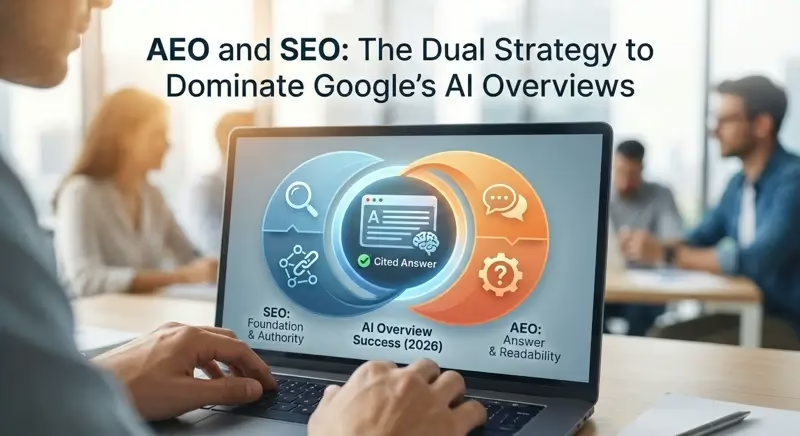
This dual strategy is not about replacing Search Engine Optimization; it is about enhancing it with Answer Engine Optimization. While SEO still provides the essential foundation of technical health, authority, and relevance, AEO adds a crucial layer. It focuses on structuring content for machine readability and direct answer extraction. It’s the difference between helping Google find your page and helping Google’s AI understand and use your expertise.
By aligning these two disciplines, you can fortify your digital presence against traffic erosion. This allows you to position your brand as an authoritative source worthy of citation. The following AEO and SEO guide provides a framework for integrating these strategies. It will ensure your content is optimized for both traditional discovery and the new AI-driven answer economy.
The Search Revolution: Why a Dual AEO and SEO Strategy Is the New Standard
The era of a search results page being a simple list of blue links is over. For years, the primary goal was securing the number one spot. Today, that position’s value is changing dramatically with the rollout of Google AI Overviews. These features aim to provide direct, synthesized answers at the very top of the results, fundamentally altering user behavior.
This evolution is powered by advanced AI, such as Google’s Gemini, which excels at understanding context and providing conversational, all-in-one responses. The result is rapid growth in zero-click answers, where users find what they need without clicking through to a website. This presents a significant threat to traditional traffic models. Even a top-ranking page may receive fewer visitors if its key information is summarized by the AI. A cohesive strategy for AEO and SEO is the only way to adapt.
Key Stat: As of April 2025, an Ahrefs study reported that when AI Overviews are present in search results, the click-through rate for the #1 organic position can drop by as much as 34.5%.
This new landscape demands more than just traditional optimization. A dual AEO and SEO approach is now essential for survival and growth. Marketers must now focus on:
- Optimizing for conversational and long-tail queries.
- Structuring content for direct answer extraction.
- Building authority to become a cited source within AI summaries.
Simply helping search engines find your page is no longer enough. You must also help their AI understand and use your information. This ensures your expertise is featured directly within the answer itself.
Core Principles of the AEO and SEO Framework
To master the new search landscape, you must understand the two disciplines at its core. Traditional Search Engine Optimization (SEO) is the foundational practice of improving a website to increase its visibility in search engine results pages on platforms like Google and Bing. Its goal is to rank web pages by signaling relevance and authority. This process relies on understanding Semantic Search, which is how engines interpret contextual meaning beyond just keywords.
Answer Engine Optimization (AEO), in contrast, focuses on making your content’s information digestible for AI to use in generated answers. The objective is not just to rank a page, but to have your information directly featured within an AI Overview or chatbot response from platforms like Microsoft Copilot. While SEO brings users to your website, AEO ensures your brand’s expertise is the answer itself. Exploring different Answer Engine Optimization strategies is key to staying ahead.
The bridge connecting the two fields is the Knowledge Graph, Google’s vast database of interconnected facts about people, places, and things. Structuring your content around these “entities” provides the clear, contextual data that AI models need to deliver accurate answers and trust your content. A solid technical foundation is the prerequisite for any successful AEO and SEO strategy.
Key prerequisites include:
- Technical Health: A fast, mobile-friendly, and easily crawlable site is non-negotiable.
- Structured Data: Using schema markup helps explicitly define entities and their relationships for machines.
- E-E-A-T: Demonstrating Experience, Expertise, Authoritativeness, and Trustworthiness is paramount.
AI models are designed to filter out misinformation and cite only the most credible sources. Therefore, proving your E-E-A-T is the minimum requirement to be considered a trustworthy source for AI-generated answers.
Content for Conversation: Crafting High-Information-Density Answers
The era of “keyword stuffing” is definitely over. Modern search engines, powered by advanced Natural Language Processing (NLP), prioritize context and meaning. This shift renders old optimization tricks obsolete. NLP allows an AI to understand the intent behind a query, not just the specific words used. This demands a more sophisticated approach to how we handle AEO and SEO.
To satisfy AI models, structure your content for easy parsing. Use clear, hierarchical heading tags (H2, H3) to create a logical question-and-answer format. This guides human readers and allows AI to quickly extract specific answers, increasing your chances of being featured in an AI Overview. Think of each heading as a direct question and the subsequent paragraph as the immediate, concise answer.
This leads to the concept of high-information-density content. It’s about being exceptionally concise, factual, and providing real-world examples without introductory fluff. The goal is to pack the most value into the fewest words, as AI models favor sources they can process efficiently. Mastering the dual strategy of AEO and SEO requires this directness, proving your expertise through clear, data-rich answers.
To optimize for AI search, you must also target the conversational and long-tail queries that frequently trigger AI Overviews. These are often full questions that your audience is asking.
To identify and answer these queries:
- Use H-tags to pose common questions your audience has.
- Provide direct, factual answers immediately following the heading.
- Brainstorm query variations with a tool like ChatGPT to understand conversational phrasing.
- Focus on specific, multi-word phrases that indicate high user intent.
💡 Pro Tip: Leverage a content intelligence platform like MarketMuse to analyze your topical authority and discover content gaps. Such tools can reveal the precise questions your audience is asking. This allows you to build comprehensive, high-density content that establishes your expertise and satisfies both AI and human readers.
Technical Symbiosis: Supercharging AEO and SEO with Schema Markup
To help search engines and AI models understand your content, you need to speak their language. This is where structured data comes in. It acts as a translator, adding explicit context to your webpage’s content. Think of it as a clear set of labels for search engines.
The most common vocabulary for this is Schema.org, a collaborative project providing a standardized set of definitions. Using website schema markup is a shared language that removes guesswork. It allows you to tell an AI that a specific piece of text is a person’s name, a date, or an event. This data is typically implemented using JSON-LD, Google’s preferred format. JSON-LD neatly packages the schema information without interfering with your site’s visual layout.
For example, without a schema, a search engine sees: “The article was written by Casey.” With a schema, you can explicitly define “Casey” as the author. This is a powerful signal for establishing expertise. This clarity is a foundational element of a robust AEO and SEO strategy.
To maximize visibility in AI-driven results, focus on implementing a schema that directly answers informational needs.
- Article Schema: Essential for any blog or news content. It clarifies the headline, author, and publication date, signaling your content is a properly structured, informative piece.
- FAQPage Schema: This markup directly structures your question-and-answer content. It is ideal for pages that address common user questions and is a prime candidate for inclusion in AI Overviews.
- Person Schema: When tied to your author bios, this schema helps validate authorship. It establishes who is behind the content, reinforcing the E-E-A-T signals that both readers and AI systems value.
- Organization Schema: This schema helps define your brand as a distinct entity. It specifies your official name, logo, and contact information. This strengthens your brand’s presence in the Knowledge Graph and builds credibility.
While this may sound technical, implementation has become much simpler. For WordPress users, plugins like Yoast and RankMath have built-in schema capabilities that automate much of the process. These tools can generate the necessary schema types with minimal manual input. This makes it easier to provide search engines with the clean, machine-readable data they require when evaluating AEO and SEO.
Building Authority and Trust: Why E-E-A-T Is Non-Negotiable for AEO and SEO
In an information landscape shaped by AI, establishing trust is the core of a modern AEO and SEO strategy. This is where Google’s E-E-A-T framework becomes critical. E-E-A-T stands for Experience, Expertise, Authoritativeness, and Trustworthiness. It is a set of signals Google uses to evaluate content quality, with Trust as the most crucial element.
AI models powering Google’s AI Overviews are trained to prioritize sources that demonstrate strong E-E-A-T. These systems aim to deliver reliable results, making your credibility a direct ranking factor. This principle extends beyond traditional search to voice assistants like Siri and the Google Assistant, which also parse vast amounts of data to provide trustworthy answers. As Itamar Haim, a web creation expert, notes, “If you want an AI to respect your content, you have to speak its language, which, ironically, is the language of a helpful, expert human.”
Demonstrating E-E-A-T is a tangible process. You can strengthen these signals by adhering to established best practices.
- Showcase Real-World Experience: Move beyond summarizing what others have said. Create content with original photos, case studies, or detailed tutorials that demonstrate firsthand knowledge.
- Highlight the Author: Include a real name and a detailed biography with your content. An author bio should list credentials, relevant experience, publications, and social profiles. This proves a knowledgeable person is behind the information.
- Cite Sources and Experts: Increase authority by linking to reputable sources and including quotes from recognized experts. This shows your content is well-researched.
- Keep Information Current and Accurate: Regularly update your content for accuracy. For local businesses, maintaining a complete and current Google Business Profile is a powerful way to demonstrate trustworthiness for local search.
Measuring Success: The New KPIs for a Combined AEO & SEO Approach
In the age of Google AI Overviews, traditional metrics like traffic and rankings only tell part of the story. To truly gauge performance, you must adopt new Key Performance Indicators (KPIs). These should focus on visibility within AI-generated answers. Success is no longer just about bringing users to a page but about becoming the answer itself.
This requires a shift toward AEO-centric metrics. Instead of only tracking page views, start measuring citation volume, how often your site is credited as a source in an AI response. Monitor your share of voice within AI answers to see how your visibility compares to competitors. Finally, track unlinked brand mentions, as these build authority even without a direct click.
Tools like Google Search Console remain valuable. However, you’ll need to dig deeper. As of January 2026, GSC data merges AI Overview data with standard results. You can still spot trends like rising impressions without a corresponding click growth, which may indicate AIO visibility. For more direct insights, platforms like Semrush and Ahrefs are developing features to track visibility in SERP features that feed AI Overviews. This will help you connect your AEO and SEO efforts to generative responses.
💡 Pro Tip: Set up custom dashboards to segment traffic from identifiable AI sources. Analyze the on-site behavior of these visitors, such as conversion rates and pages per session, to measure the quality of traffic. Visitors arriving from AI Overviews are often more qualified and show higher intent.
Ultimately, a holistic view is essential. A unified reporting dashboard can measure your AEO and SEO strategy by combining new and traditional metrics:
- AEO Visibility: Citation volume and share of voice in AI answers.
- SEO Performance: Organic traffic and keyword rankings for core topics.
- Traffic Quality: Conversion rate and engagement from AI-referred visitors.
- Brand Authority: Growth in both linked and unlinked brand mentions.
This combined approach ensures you are not just driving traffic but building lasting authority in an AI-first search landscape.
The Future of Search: A Unified Path for AEO and SEO
The rise of Google’s AI Overviews represents a fundamental evolution in search, demanding more than traditional optimization. Success is no longer measured solely by clicks but by your ability to become the cited authority within AI-generated answers. This requires a deliberate shift from a singular focus on SEO to a holistic, dual-pronged strategy that embraces both AEO and SEO. By becoming the source, you build unmatched authority.
By weaving expertise into your content and adopting new KPIs, such as citation volume, you can grow your influence. A cohesive AEO and SEO strategy is your blueprint for not only navigating this change but dominating it.
Ready to take the next step and future-proof your digital strategy? The team at AgenticPress specializes in creating unified AEO and SEO frameworks that drive authority and results in the new age of search. Contact AgenticPress today to ensure your brand becomes the definitive answer.
Website: AgenticPress
Last verified: January 2026